
SaaS content marketing has a credibility problem: the top Google result for the phrase is a Reddit thread arguing that it no longer works. The skeptics have a point about the old playbook. Pew Research found that Google users clicked a regular search result 8% of the time when an AI summary appeared, against 15% when it did not.
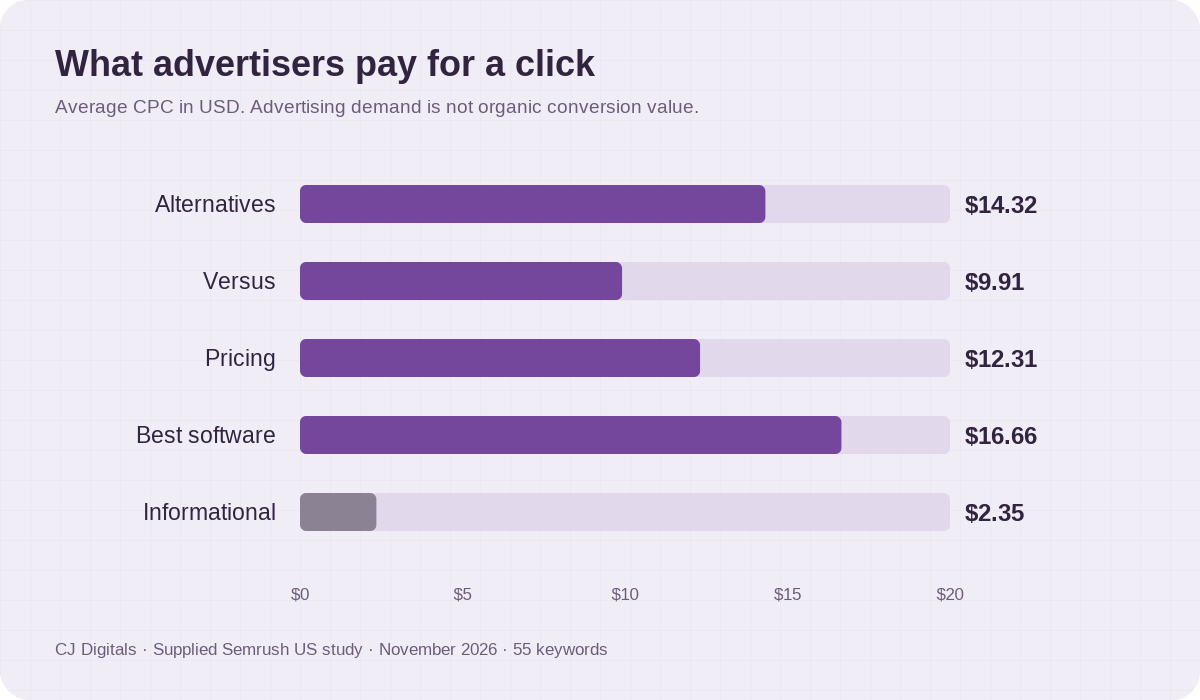
Our 55-keyword sample suggests a practical place to start: searches made by people comparing software. Alternatives keywords had an average CPC of $14.32, compared with $2.35 for informational queries, a 6.1-fold gap. CPC measures advertising demand, not organic conversion value. This guide combines that sample with a 12-week publishing plan and a way to measure enquiries, trials and pipeline.
What Is SaaS Content Marketing?
SaaS content marketing is the practice of publishing articles, comparison pages, tutorials and other content that help software buyers solve a problem with your product. It targets searches made at every stage of the buying process, and it measures success by sign-ups and demo requests, with traffic as a secondary signal.
Two things set it apart from content marketing for other businesses. SaaS buyers can try the product before they pay, so content often ends in a free trial or a demo instead of a contact form. Customers also pay every month, which means tutorials and help content keep them from canceling long after the first sale.
Is SaaS Content Marketing Dead in the Age of AI Overviews?
Generic SaaS content is losing clicks, while content written for buyers who are ready to choose a tool still performs. The difference comes down to which searches trigger AI summaries and what people do after they see one.
In Pew Research Center's study of browsing data from 900 US adults, users clicked a link inside an AI summary on just 1% of visits to pages with one. Pew also found that longer, question-style searches trigger AI summaries more often. Only 8% of searches with 1 or two words produced a summary.
That pattern matters for SaaS teams. "What is CRM" and "how to take notes" are the questions AI answers well. "HubSpot alternatives" and "QuickBooks vs Xero" are short, commercial searches from people comparing products, and they still send buyers to pages that help them decide.
Google keeps expanding AI features, so the picture will shift. At I/O 2026, Google said AI Overviews reach more than 2.5 billion people a month. Treat the click data as a direction of travel, and expect informational traffic to keep shrinking.
What Does Our Keyword Data Show About SaaS Buyer Searches?
Comparison searches cost far more to buy and are easier to rank for than informational searches. We pulled US search volume, keyword difficulty (KD) and cost per click (CPC) from Semrush in November 2026 for 55 keywords across 11 SaaS categories, from CRM and help desk software to transcription tools. For each category we checked "[product] alternatives," "[product] vs [rival]," "[product] pricing," "best [category] software" and an informational question.
| Search type | Example | Average CPC | Median KD | Combined monthly US searches |
|---|---|---|---|---|
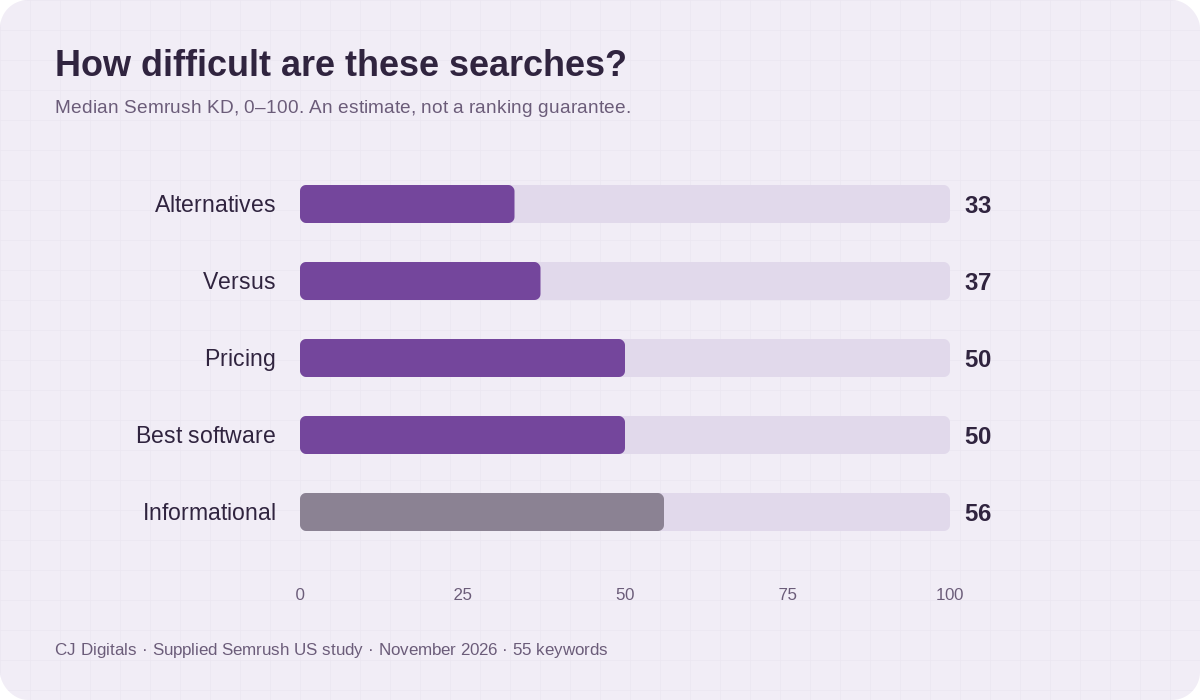
| Alternatives | hubspot alternatives | $14.32 | 33 | 24,690 |
| Versus | quickbooks vs xero | $9.91 | 37 | 26,590 |
| Pricing | zendesk pricing | $12.31 | 50 | 171,700 |
| Best software | best help desk software | $16.66 | 50 | 45,200 |
| Informational | what is crm | $2.35 | 56 | 106,560 |
Read the data notes
Reading the data: this is a selected sample of 55 keywords, with 11 keywords per search type, rather than a representative survey of all SaaS demand. CPC is an estimated paid-search price; KD is Semrush’s difficulty estimate. Neither predicts your conversion rate or guarantees a ranking. The figures summarize the research supplied for this article; the named examples and 12-week plan were spot-checked on 23 November 2026. Pew’s click findings concern US browsing in March 2025 and do not establish that every short commercial query avoids AI Overviews.
How difficult are these searches?
Source: CJ Digitals analysis of Semrush US data, November 2026. Categories: project management, CRM, email marketing, note-taking, video conferencing, design, accounting, scheduling, SEO tools, help desk and transcription.
Here is what the numbers say:
- Alternatives searches cost 6.1 times more per click than informational searches ($14.32 against $2.35), and they cost more in 10 of the 11 categories.
- They are also easier to rank for. Their median KD of 33 falls well below the informational median of 56, and the alternatives keyword had the lower KD in 10 of 11 categories.
- Informational questions bring 4.3 times the volume of alternatives searches, which explains why so many SaaS blogs still lead with them.
- Pricing searches have the biggest volume at 171,700 a month, and each of them includes a brand name, so the vendor's own pricing page is the natural answer.
- "Best [category] software" searches carry the highest average CPC at $16.66, which makes roundup pages worth the effort for any tool that belongs on the list.
The widest gap in the data comes from customer support software. Advertisers pay $48.04 per click for "zendesk alternatives" and $0.85 for "what is customer service," a gap of about 56 times. The gap suggests stronger advertiser demand for this comparison query. Test its value with qualified conversions and customer revenue rather than treating CPC as the value of an organic visit.
How Do You Build a SaaS Content Marketing Strategy?
Build it in the order buyers spend money, starting at the bottom of the funnel and working up. Each section below covers a single stage of that process, with an example you can adapt.
Map the Jobs Your Product Does Before You Open a Keyword Tool
Start with the problems customers hire your product to solve, and only then look for matching searches. Keyword tools show demand, but they cannot tell you which problems your product handles better than anyone else.
Pull your inputs from recorded sales calls, support tickets, onboarding questions and cancellation reasons. A help desk tool might hear "our shared inbox is a mess" on 30 sales calls in a quarter. That phrase points to searches like "shared inbox vs help desk" and "how to manage a support inbox," and the product answers both.
Score Every Topic for Business Potential
Give each topic a score from 0 to three based on how naturally your product fits the answer, and write the topics that score two or three first. Ahrefs popularized this "business potential" score as the core of its product-led content method, and its team prioritizes topics that score a two or a three.
"Product-led content is content that helps the reader solve their problems using your product."
Si Quan Ong, Ahrefs
Here is the scale applied to a fictional AI transcription app, using real Semrush volumes:
Illustrative plan for a fictional transcription app · US keyword data
| Score | Meaning | Example topic | Monthly US searches |
|---|---|---|---|
| 3 | The product is the main answer | zoom transcription | 1,900 |
| 2 | The product helps, but other options work | how to transcribe an interview | 320 |
| 1 | The product gets a brief mention at most | meeting notes template | 12,100 |
| 0 | The product has no natural place | history of shorthand | Skipped |
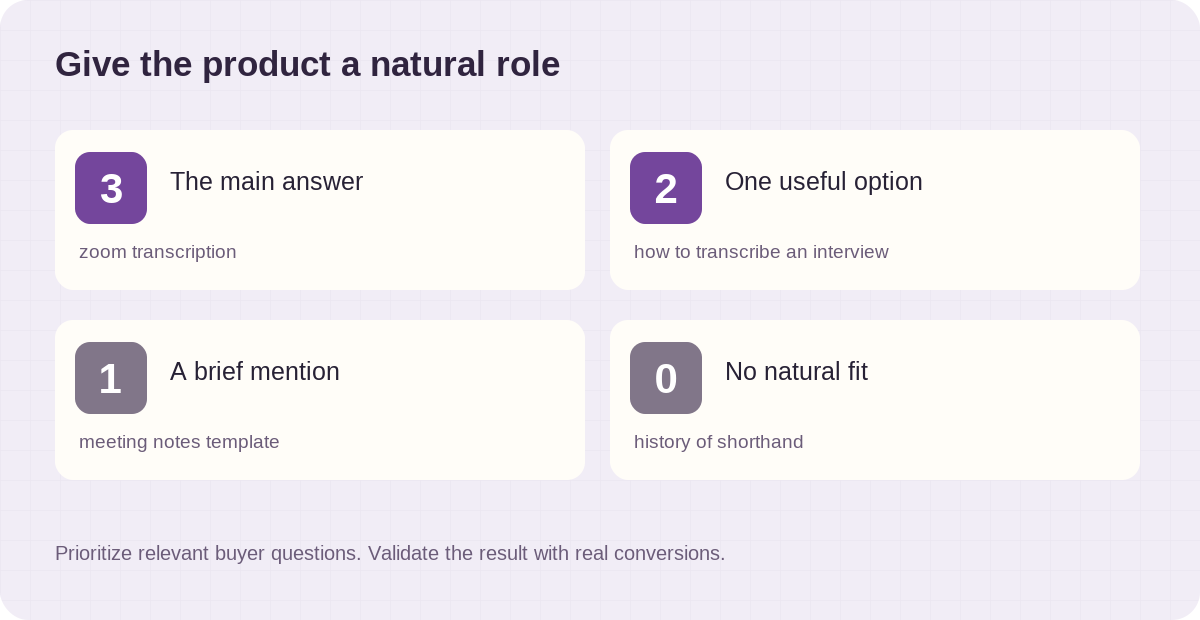
The template keyword has 6 times the volume of "zoom transcription," yet it scores lower. A reader who wants a free template has no reason to start a trial, while a reader searching for Zoom transcription is describing the exact job the app does.
Publish Alternatives and Comparison Pages First
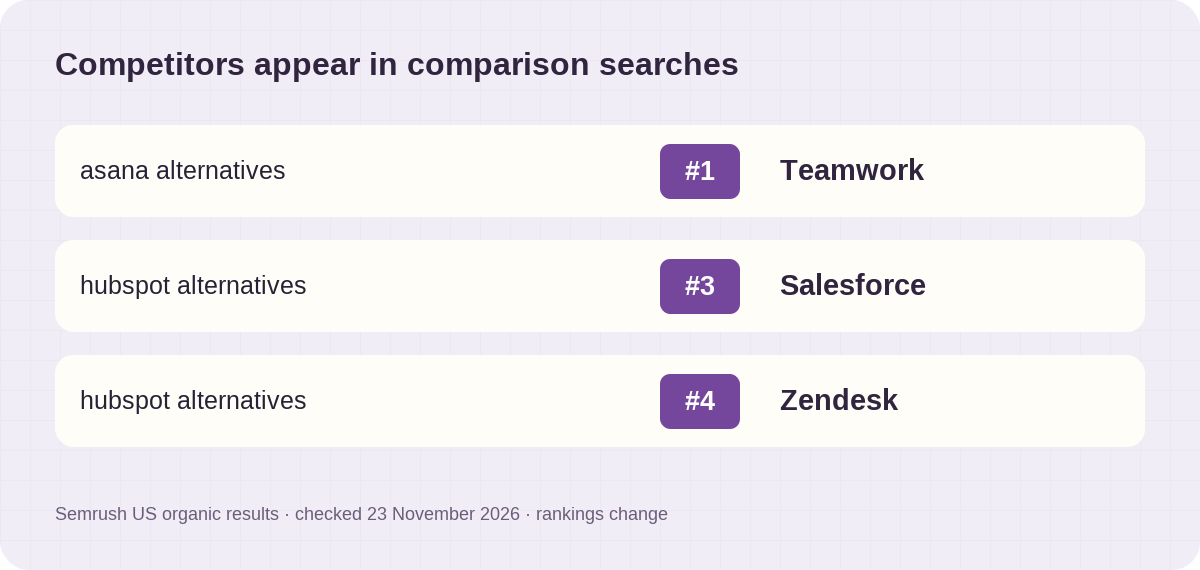
Comparison pages reach buyers at the moment they choose a vendor, and the data above shows they are often easier to rank. Your competitors already know this. Here is who ranked in Google's top 6 for three "alternatives" searches in November 2026, according to Semrush:
- "asana alternatives": Teamwork, an Asana competitor, ranked first with a post on its own blog.
- "hubspot alternatives": Salesforce ranked third and Zendesk ranked fourth, both with pages that position their own products.
- "zendesk alternatives": Kayako, Brilo, Hiver and Front all held top 6 spots.
- Publishers win too: Zapier's blog ranked on both the HubSpot and Asana searches with independent roundups.
A comparison page only converts when readers trust it. Build each page with these elements:
- A "best for" line for every tool, including the competitor you are comparing against.
- An honest section on when the reader should stay with the incumbent.
- Current prices with the month you checked them, plus a link to each vendor's pricing page.
- Screenshots of the same task done in each product.
- A clear next step for readers who decide your product fits.
Turn Features Into Tutorials That Solve a Real Problem
Write how-to content where your product does the work, and show the free method alongside it. Ahrefs built much of its blog this way, with tutorials that teach an SEO task step by step inside its own tools.
Take "how to transcribe a zoom meeting," a keyword with 210 US searches a month and a KD of 28. A strong article first shows Zoom's built-in transcript, then shows where an AI transcription app saves time, such as speaker labels or summaries. Readers get a complete answer, and the product appears as the faster option instead of the only option.
Organize Content Into Hubs Buyers and AI Models Can Follow
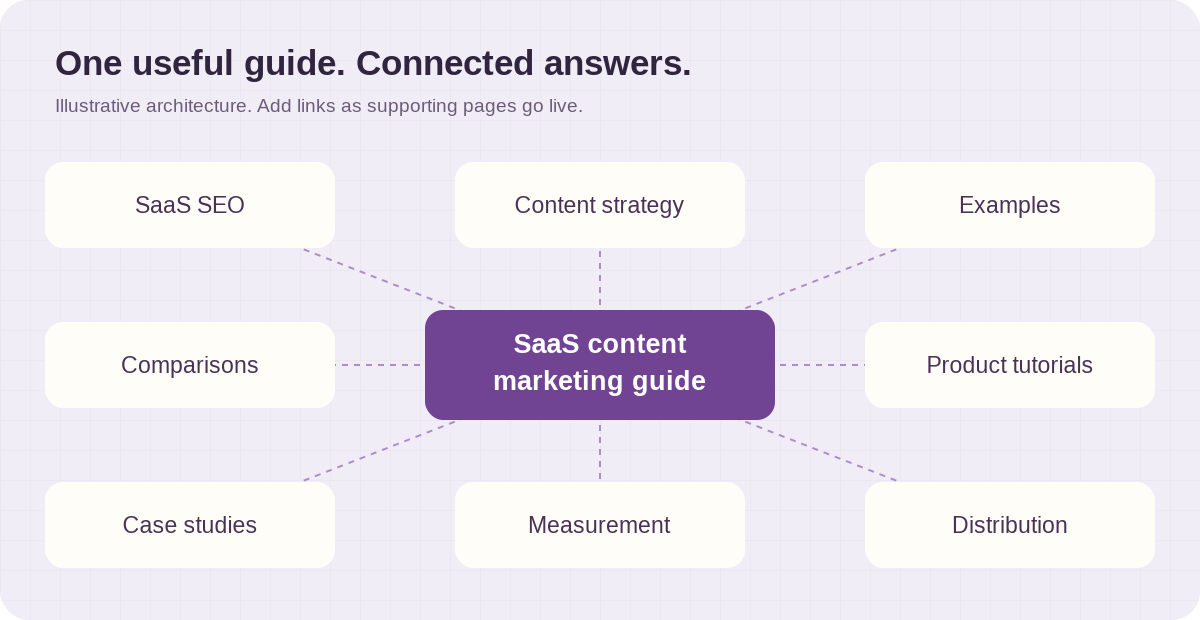
Group related articles under one hub and link relevant pages both ways. For a SaaS content hub, useful supporting topics include SEO, content planning, examples, comparison pages and case studies. Add each internal link when its destination is published.
Use the same product name, category label and feature names on every page. Inconsistent naming makes it harder for search engines and AI models to connect your pages to a single entity.
Write Every Page So AI Answers Can Quote It
Open each section with a direct answer, back claims with named sources and add numbers wherever you have them. AI answers pull short, self-contained passages, and those habits make your passages easy to lift.
Research supports this. In the GEO study from researchers at Princeton and partner universities, adding quotations and statistics produced the largest visibility gains in AI-generated answers of all the methods they tested, and citing sources also helped. Our guide to generative engine optimization breaks down each method with examples.
For SaaS pages, put these habits into practice:
- Start every H2 section with a short, direct answer to the question in the heading.
- Use real HTML tables for pricing, features, integrations and comparisons.
- Show the date you last checked prices and features near the top of the page.
- Keep product facts identical across your site, docs, review profiles and press pages.
- End long guides with an FAQ that answers real follow-up questions in a few short sentences each.
Show Up Where Buyers Ask Each Other: Reddit and Communities
Join the threads where buyers compare tools, because those threads now rank above most vendor pages. The Semrush data above showed Reddit in the top two for all 4 searches we checked, including the main keyword for this guide.
Community work only helps when it reads as help. Use accounts with real history, disclose that you work for the company, follow each subreddit's self-promotion rules and answer the question asked before you mention your product. A useful reply often links to your comparison page, since that page already presents the options fairly.
Reuse Each Article Across Sales and Customer Emails
Give every article a second job outside search. Sales reps can send a comparison page after a demo when a prospect mentions a rival. Customer success teams can add tutorials to onboarding emails, and marketing can turn data from a guide into a newsletter issue or a founder's LinkedIn post.
A single research asset can feed all of these. The keyword table in this guide, for example, could become a newsletter chart and a slide in a sales deck.
How to Measure SaaS Content Marketing by Pipeline
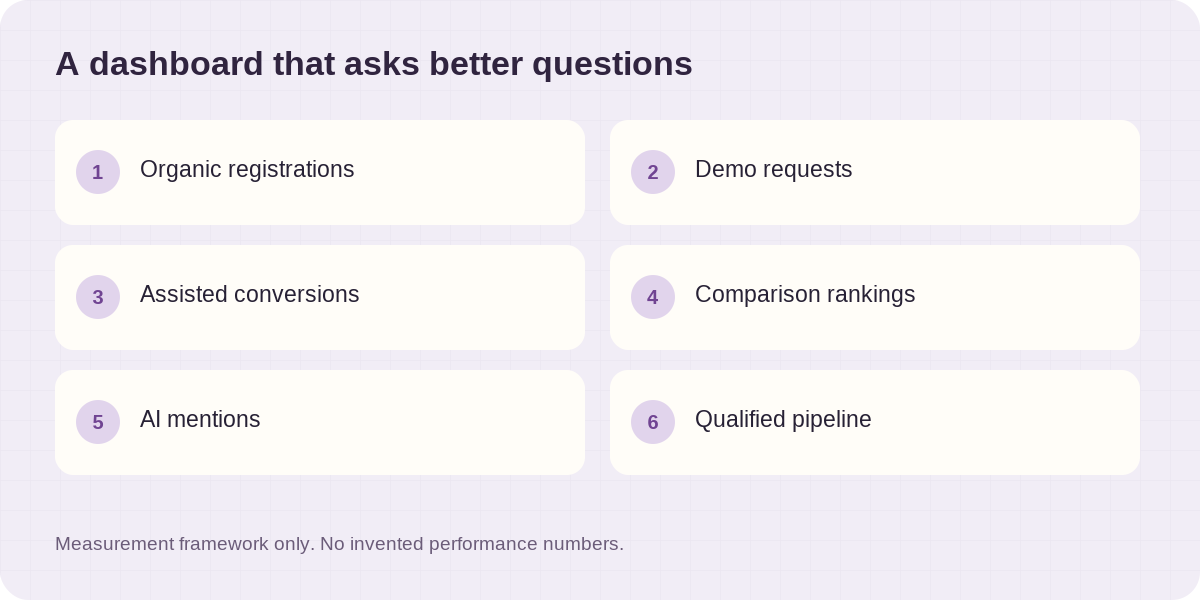
Measure the sign-ups and revenue that content influences, and treat traffic as an early signal. Set up tracking before you publish, because you cannot rebuild attribution for months that already passed.
| Metric | What it tells you | Where to find it |
|---|---|---|
| Sign-ups and demo requests from organic search | Whether content creates buyers | Key events in Google Analytics 4 |
| Self-reported attribution | Which pages and channels buyers remember | A "How did you hear about us?" field on sign-up forms |
| Assisted conversions | Content read before a conversion on another channel | GA4 attribution paths |
| Rankings for comparison keywords | Progress on your highest-value searches | Any rank tracker |
| AI answer mentions | Whether ChatGPT, Gemini, Perplexity and Google AI Mode recommend you | A fixed list of buyer prompts checked each month |
| Content-sourced pipeline | Revenue tied to content | First-touch and UTM data in your CRM |
What Does a 90-Day SaaS Content Plan Look Like?
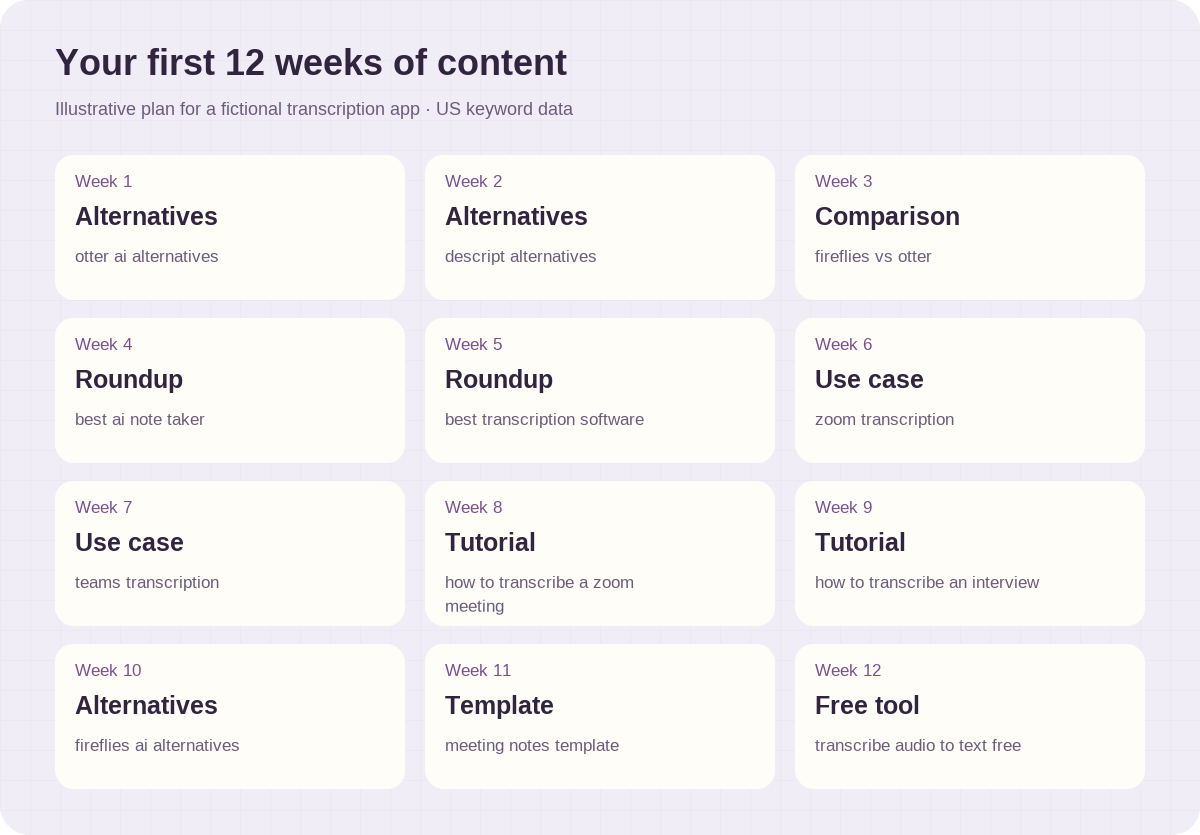
A good first quarter starts with low-difficulty comparison pages, moves to category roundups and use cases, and saves the hardest informational keywords for last. The table below applies that order to a fictional AI transcription app, using real US data from Semrush in November 2026.
Illustrative plan for a fictional transcription app · US keyword data
| Week | Keyword | Monthly searches | KD | CPC | Business potential | Page type |
|---|---|---|---|---|---|---|
| 1 | otter ai alternatives | 390 | 30 | $6.38 | 3 | Alternatives page |
| 2 | descript alternatives | 320 | 15 | $6.88 | 2 | Alternatives page |
| 3 | fireflies vs otter | 110 | 34 | $7.02 | 2 | Comparison page |
| 4 | best ai note taker | 1,300 | 44 | $4.93 | 3 | Roundup |
| 5 | best transcription software | 880 | 40 | $6.39 | 3 | Roundup |
| 6 | zoom transcription | 1,900 | 39 | $5.05 | 3 | Use case |
| 7 | teams transcription | 720 | 29 | $5.02 | 3 | Use case |
| 8 | how to transcribe a zoom meeting | 210 | 28 | $3.58 | 3 | Tutorial |
| 9 | how to transcribe an interview | 320 | 33 | $2.51 | 2 | Tutorial |
| 10 | fireflies ai alternatives | 50 | 9 | $5.14 | 3 | Alternatives page |
| 11 | meeting notes template | 12,100 | 44 | $2.08 | 1 | Free template |
| 12 | transcribe audio to text free | 6,600 | 73 | $2.21 | 2 | Free tool page |
Which SaaS Content Mistakes Waste the Most Budget?
- Starting with glossary posts. Definitions attract the most volume, but AI summaries answer them. In our data they also had the lowest CPC of any search type.
- Writing comparison pages that trash rivals. Buyers recognize one-sided pages quickly, and Reddit threads often call them out by name.
- Publishing at volume without product insight. Google's guidance warns that generating many pages without adding value may violate its spam policy on scaled content abuse.
- Reporting traffic alone. A post with 20,000 visits and no sign-ups costs more than it returns.
- Letting product facts go stale. Old prices and retired features on comparison pages break trust with buyers and feed AI answers wrong information.
What Should You Publish This Month?
Pull the alternatives and comparison keywords for your 4 closest competitors this week, score each keyword for business potential and publish the two highest scorers first. Then read our guide to getting cited in AI answers before you write them, so each page is ready for both Google rankings and AI answers.
CJ Digitals plans and writes product-led content for SaaS teams, from comparison pages and tutorials to Reddit and newsletter programs.
SaaS Content Marketing FAQs
How do you measure SaaS content marketing?
Track sign-ups and demo requests from organic search as key events in Google Analytics 4, and add a "How did you hear about us?" field to sign-up forms. Review assisted conversions, rankings for comparison keywords and monthly AI answer mentions alongside them. Traffic matters only as an early signal.
How long does SaaS content marketing take to show results?
Most programs need several months before organic sign-ups become steady. Low-difficulty comparison pages tend to rank sooner than broad informational guides, which gives you another reason to publish them first.
Is a content marketing retainer worth it for a SaaS startup?
Assess a retainer against qualified enquiries, customer acquisition cost and gross profit. At the estimated $48.04 CPC for “zendesk alternatives,” 100 paid clicks would imply $4,804 in media spend before other costs. That is an illustrative paid-media comparison, not measured savings from 100 organic visits. Organic and paid traffic can convert differently; use your own conversion and retention data to judge the investment.
Can a single person run B2B SaaS content marketing?
A single person can run an early program with regular access to customers and product experts. That person should focus on comparison pages and tutorials, then add writers or an agency once those pages start producing sign-ups.
What is the difference between SaaS content marketing and SaaS SEO?
SaaS SEO covers ranking in search engines, including technical fixes and links. SaaS content marketing is broader: it includes the content that ranks, plus distribution through communities, newsletters, sales teams and customer emails.
Should SaaS companies use AI to write content?
Google's guidance says generative AI can help with research and structure, but mass-producing pages without added value may violate its scaled content abuse policy. The content that wins for SaaS depends on product knowledge and original data, which a team has to supply.

Viraj Mahajan
Founder of CJ Digitals and a professional writer since 2010. Viraj works on content strategy, SaaS writing and search visibility.